Cet article n’est pas encore disponible en français : il est affiché en anglais.
Kling 4.0 vs Wan 3.0 vs Seedance 2.5: We Tested October's Newest AI Video Models
Kling 4.0, Wan 3.0 and Seedance 2.5 are the three AI video models everyone is talking about this month. We ran the same two prompts through all three and compared motion, camera control, sound and price per clip, with every clip below.
Par Opeek6 min de lecture
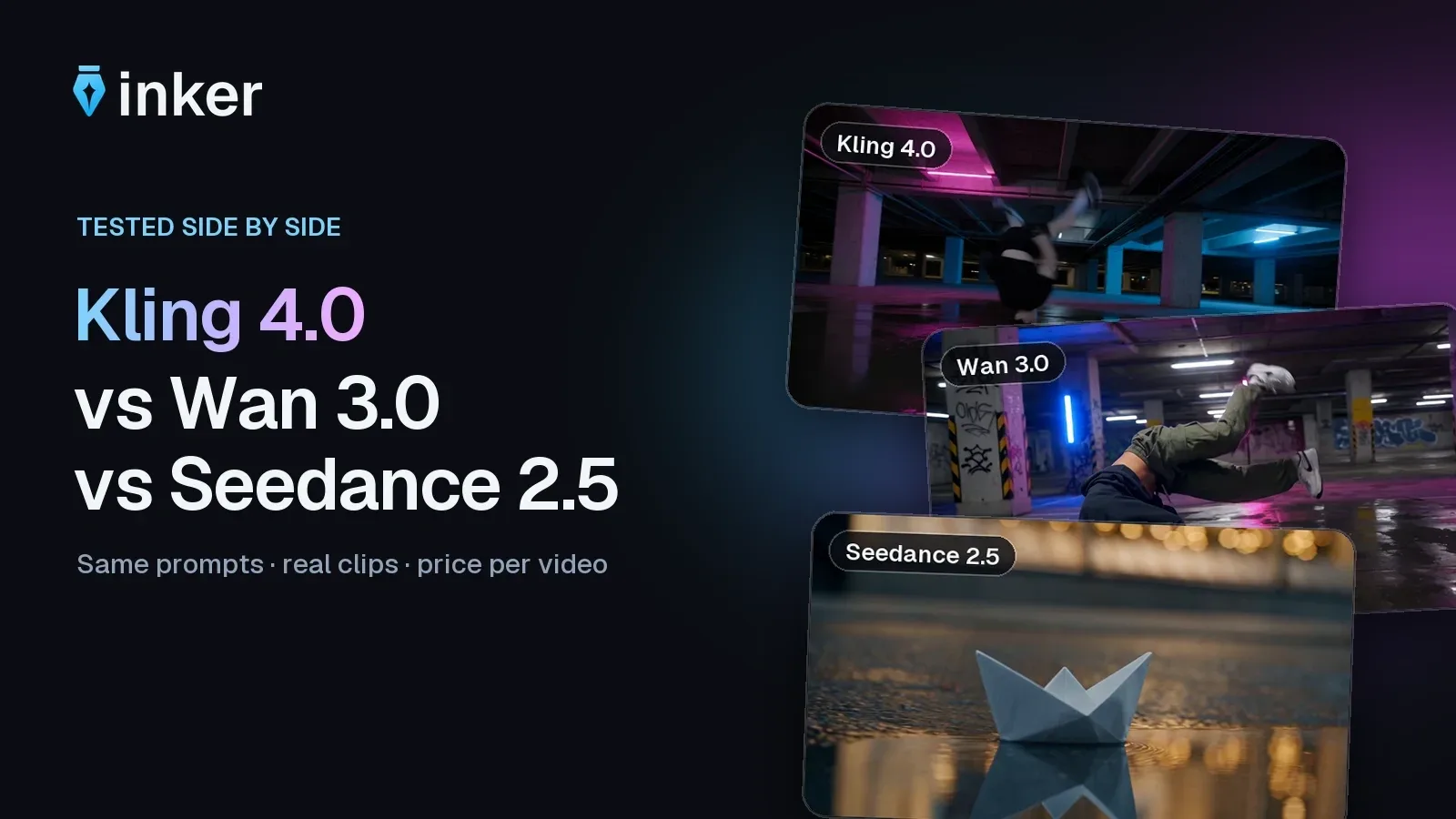
Short answer: for camera-led action (tracking shots, a camera following a subject), pick Kling 4.0. For the best value at 1080p with sound, pick Wan 3.0: at 171 coins it's the cheapest of the three. For the most cinematic, filmic look (shallow depth of field, moody light), pick Seedance 2.5, at the highest price. All three make 5-second clips with native sound from one prompt, and you can run all three from one coin balance on inker, with no subscription.
The three models at a glance
| Kling 4.0 | Wan 3.0 | Seedance 2.5 | |
|---|---|---|---|
| Made by | Kuaishou | Alibaba | ByteDance |
| Released | October 2026 | 2026 (public beta from August) | Summer 2026 |
| Inputs on inker | Text, or a start and end frame | Text or a start image | Text or a start image |
| Clip length on inker | 3–20 s | 2–20 s | 4–20 s |
| Resolution | 720p, 1080p | 480p–1080p | 480p–1080p |
| Native audio | Always on | On or off | On or off |
| Repeatable (seed) | No | Yes | No |
| Default clip on inker | 1080p, 5 s, 201 coins | 1080p, 5 s, 171 coins | 720p, 5 s, 404 coins |
Coin prices are inker's default settings at the time of writing, and the studio shows the exact price before every generation. In the €5 starter pack, 1 coin = €0.01. Wan 3.0 and Seedance 2.5 can each make up to 30-second clips in their makers' own apps. On inker every video model currently tops out at 20 seconds per clip.
Test 1: a breakdancer and an orbiting camera
Fast human motion is the hardest thing for a video model: limbs, balance and the floor all have to stay believable while the camera moves. Same prompt for all three, 16:9:
A breakdancer spins on his head in a neon-lit underground parking garage, then lands in a freeze pose as the camera orbits around him. Handheld tracking shot, puddles reflecting pink and blue light, gritty music-video look, echo of sneakers squeaking on concrete.
Kling 4.0 (1080p, 5 s). The most dynamic take: the dancer moves through flips and handstands while the camera travels with him. It traded the literal head spin for bigger moves, but the body stays solid at speed.
Wan 3.0 (1080p, 5 s). The closest to the brief: a clean head-freeze, a brighter set with graffiti and neon tubes, and puddle reflections exactly as asked.
Seedance 2.5 (720p, 5 s). The moodiest and most music-video: lower light, heavy motion blur on the spin, a real "shot on a camera" feel.
Test 2: a paper boat at water level
This one tests camera control and small physics: a light object on moving water, splashes and a shallow depth of field.
A paper boat sails down a rain-filled gutter on a busy city street at dusk. The camera follows at water level as it passes splashing footsteps and glowing shop windows, shallow depth of field, cinematic, sound of rain and distant traffic.
Kling 4.0. A textbook water-level follow shot: the boat really travels, and a footstep splashes right past it. The best camera control of the three.
Wan 3.0. The richest street scene, with people, umbrellas, shop windows and a splash in the foreground, but the boat bobs in place more than it sails.
Seedance 2.5. The most beautiful frame: extreme shallow focus and golden bokeh. It reads like a film still, with gentle motion rather than a journey.
Which one should you use?
Kling 4.0: when the camera matters
Kling 4.0 followed both camera instructions most literally ("orbit", "follows at water level"). Use it for tracking shots, action, product reveals and anything where you're directing the camera. On inker you can also give it a start and an end frame to control exactly where a shot begins and lands. That makes it our pick for transitions and looping clips.
Wan 3.0: best value per second
Wan 3.0 gave the most prompt-faithful scenes (the head-freeze, the graffiti, the splashing street) at the lowest price here: 171 coins for 1080p with sound. It also supports a seed, so you can re-run a prompt, change one word and keep the rest of the shot similar. That's handy when you iterate on an idea. It's our default for drafts and for social clips.
Seedance 2.5: when it has to look like film
Seedance 2.5 consistently produced the most cinematic images: the moodiest light, the creamiest bokeh and the most "real camera" texture. It also costs the most (404 coins for 720p, 5 s), so we use it for the hero shot after drafting in Wan.
A workflow that works
- Draft the idea in Wan 3.0 at 720p (or 480p) to test the prompt cheaply.
- Direct the final camera move in Kling 4.0, using a start or end frame if you have one.
- Polish the one hero shot in Seedance 2.5.
One prompt, three models and one balance, so you only pay for the clips you keep.
Prompting tips for all three
- Lead with the camera: "handheld tracking shot", "water-level follow", "slow orbit". All three respect camera language, and Kling the most.
- One action per clip. "Spins on his head, then freezes" worked better than a list of moves.
- Describe the sound. All three generate audio from the prompt: "sneakers squeaking on concrete" and "rain and distant traffic" shaped the soundtrack.
- Pick the resolution for the job: 720p for drafts and phones, 1080p for finals.
Want more ideas? See our 6 AI video prompts for TikTok, Reels and Shorts and the earlier Veo 3.1 vs Kling 3.0 comparison.
FAQ
What is new in Kling 4.0?
Kling 4.0 is Kuaishou's newest video model. It opened to all users in October 2026. It improves motion and character consistency, makes clips from text or from a start and an end frame, and generates sound with the video. Kling's own app advertises up to 30-second clips. On inker it makes 3 to 20-second clips at 720p or 1080p.
Is Wan 3.0 better than Kling 4.0?
Not across the board. In our tests Wan 3.0 matched the scene description more closely and costs less (171 vs 201 coins for a 5-second 1080p clip), while Kling 4.0 followed camera directions more precisely. Wan 3.0 was also reported first on Artificial Analysis' text-to-video-with-audio leaderboard in October.
Why is Seedance 2.5 more expensive?
Seedance 2.5 is ByteDance's premium model. It is priced per second of output, and it costs more per second than Kling 4.0 or Wan 3.0. On inker a 5-second 720p clip is 404 coins. Use 480p for cheaper drafts.
Do these models make sound?
Yes. All three generate synchronized audio with the video. On inker you can switch audio off for Wan 3.0 and Seedance 2.5; Kling 4.0 always includes it.
Can I use them without a subscription?
Yes. inker uses one-time coin packs (from €5) and shows the price before every generation. New accounts get 15 free coins after confirming their email, and if a generation fails, the coins come back automatically.
Sources: Kling 4.0 opens to all users (Let's Data Science), Wan 3.0 launch (The Next Web), Wan 3.0 on the Artificial Analysis leaderboard (SCMP), Seedance 2.5 (The Decoder). Clips are shown unedited apart from compression for the web.
À propos de l’auteur
Opeek@opeek
À lire aussi
5 min de lecture
Veo 3.1 vs Kling 3.0 : quel modèle vidéo IA choisir en 2026 ?
Les deux modèles vidéo IA les plus comparés sont Veo 3.1 de Google et Kling 3.0 de Kuaishou. Voici leurs différences en matière de durée de clip, résolution, audio, image-to-video et prix par clip, et lequel choisir selon le type de plan.
5 min de lectureEn anglais
Best AI Video Generators in 2026: Kling 3.0 vs Veo 3.1 vs Seedance 2.0 vs Hailuo 2.3
We ran the same prompts through Kling 3.0 Turbo and Hailuo 2.3 and compared them with Veo 3.1 and Seedance 2.0. Here is which AI video generator to use for realism, audio, motion and price, with real clips.
5 min de lectureEn anglais
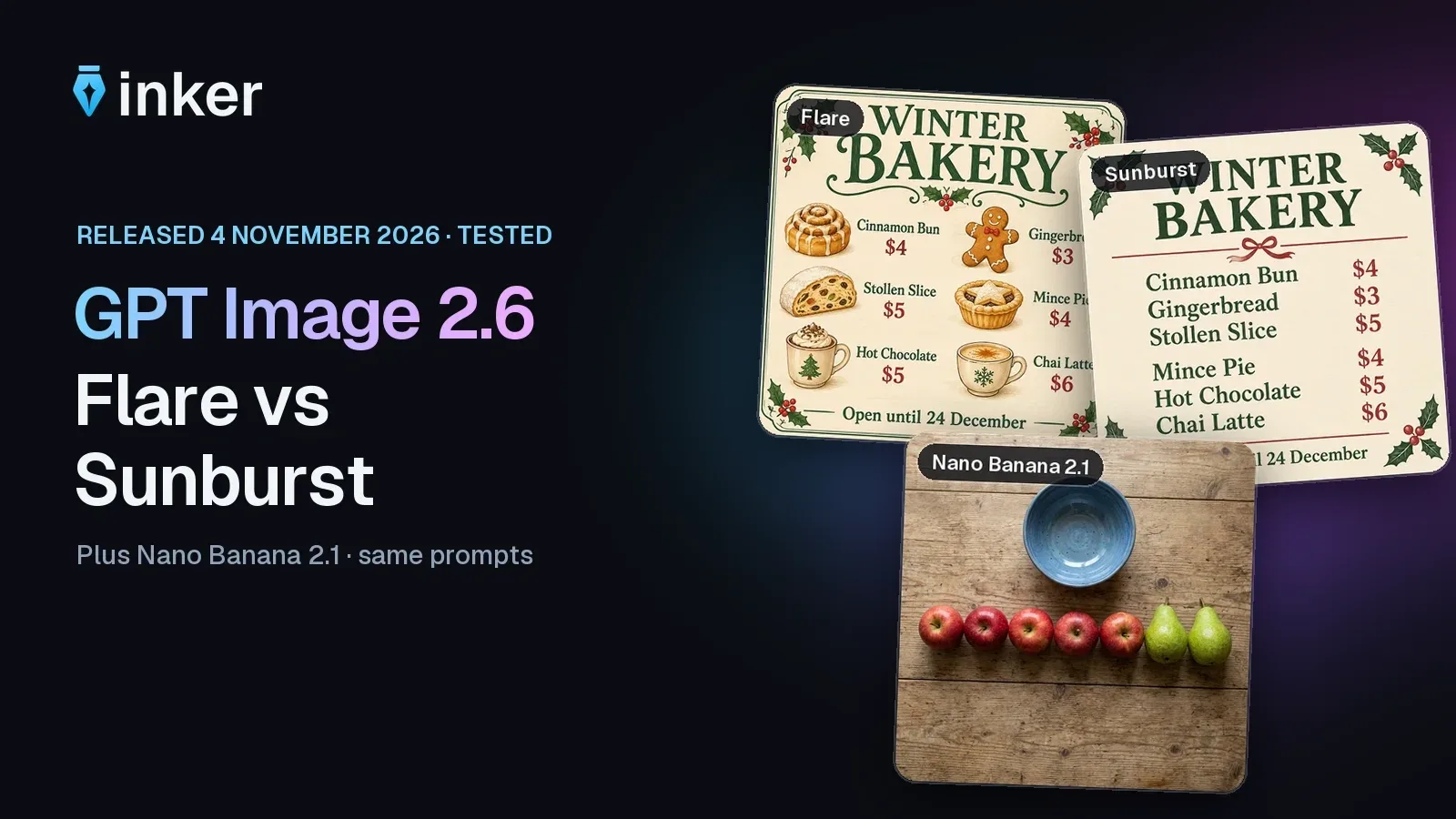
GPT Image 2.6: Flare vs Sunburst vs Nano Banana 2.1, Tested on the Same Prompts
OpenAI released GPT Image 2.6 on 4 November with two models, Flare and Sunburst. We ran the same two hard prompts through both and Nano Banana 2.1, kept the first result from each, and compared text, counting, layout and price.